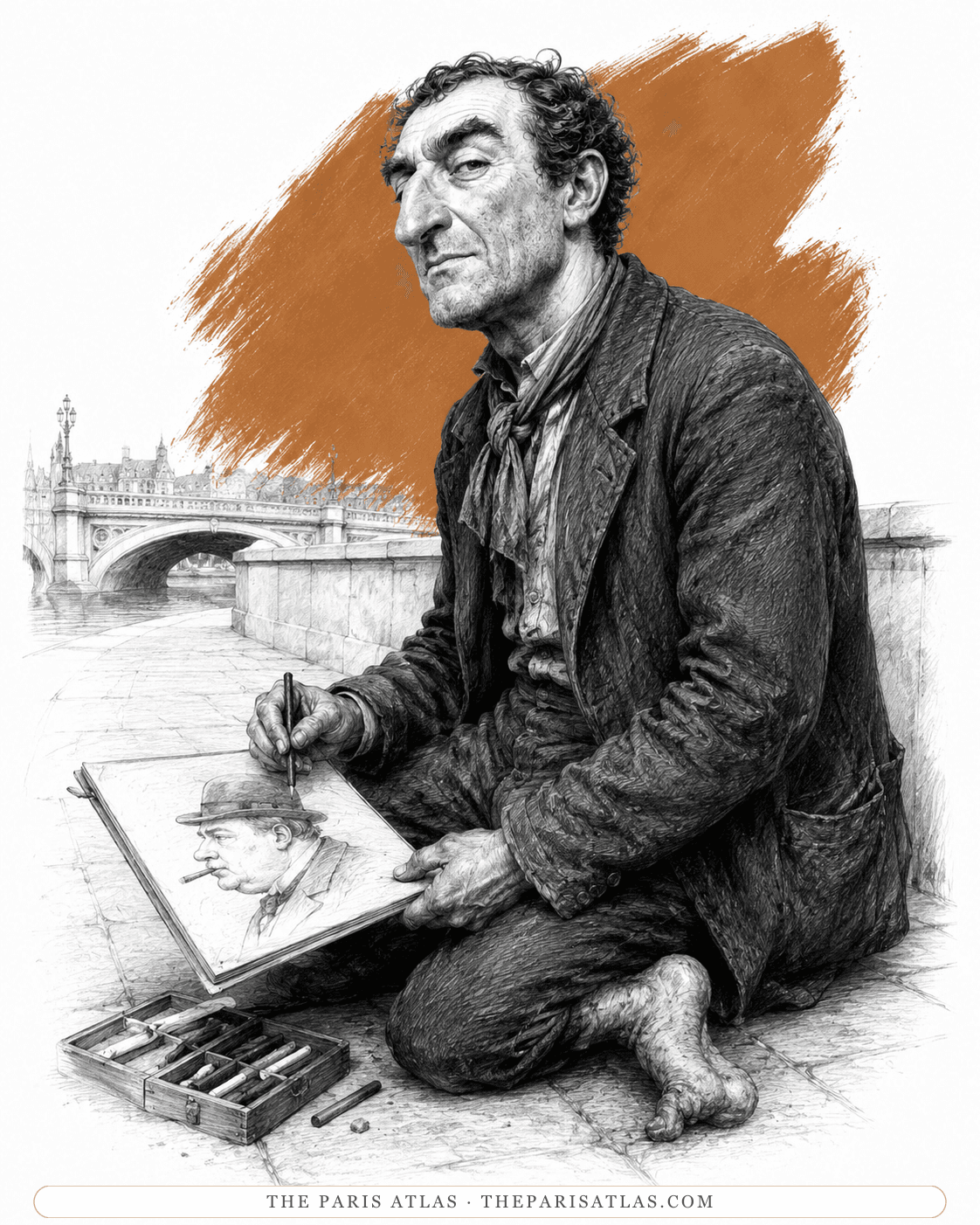
Bozo
A screever, or pavement artist, who works the Embankment near Waterloo Bridge with a box of chalks. The last news the book has of him is fourteen days in Wandsworth for begging.
To keep his mind his own. He tells Orwell that a man can live the same life rich or poor and keep on with his books and his ideas: you say to yourself, 'I'm a free man in here', tapping his forehead, and you are all right.
The book

At a glance
- Screever, meaning pavement artist, on the Embankment near Waterloo Bridge
- Son of a bankrupt bookseller; house-painter at eighteen; three years in France and India during the war; then house-painting in Paris
- Fell forty feet from a working stage in Paris and smashed his right foot. Sixty pounds in compensation
- About a pound a week over the year, up to four pounds on Boat Race and Cup Final days, nothing when it rains
- A ninepenny bed in a five-hundred-man lodging-house in Lambeth, or the spike, or the Embankment
- The clothes he stands in, his drawing materials, and a few books
- Some Zola, all of Shakespeare's plays, Gulliver's Travels and a number of essays; speaks French passably
- The London half, from Chapter XXX
Who they are in the book
Spoiler-freeBozo has no address. He is a friend of Paddy Jaques, the Irish tramp George Orwell was walking with, and Paddy had only a vague idea that he might be found in Lambeth. In the end the two of them ran across him on the Embankment near Waterloo Bridge, kneeling on the pavement with a box of chalks, copying a sketch of Winston Churchill out of a penny notebook. The likeness was not at all bad. He was small and dark, with a hooked nose he called Roman and curly hair growing low on his head. His right foot was twisted heel forward, and he walked with a stick in each hand and a sideways, crab-like gait, dragging the smashed foot behind him.
The injury has a history, which he told Orwell over several rainy days when he could not work. He was the son of a bankrupt bookseller, went to work as a house-painter at eighteen, and served three years in France and India during the war. Afterwards he took a house-painting job in Paris, saved money, and became engaged to a French girl. She was crushed to death under the wheels of an omnibus. He drank for a week, went back to work shaky, and that same morning fell forty feet from a working stage onto the pavement. He received sixty pounds in compensation, spent it in England looking for jobs, tried hawking books and selling toys from a tray, and settled at last on screeving.
He described the trade in detail and treated it as a trade rather than as begging. He called himself a serious screever: proper painters' colours rather than blackboard chalks, bought as powder and worked into cakes with condensed milk, two to five shillings' worth used in a long day, the reds most expensive. About a pound a week over the year, three pounds between a Friday and a Sunday in dry weather, up to four on Boat Race day or Cup Final day, and nothing at all when rain washes the colours off the stones.
What holds the portrait together is what he had decided about his own position. He owned the clothes he stood in, his drawing materials and a few books, and Orwell says flatly that there was no future for him but beggary and a death in the workhouse. Bozo had faced that and built a philosophy on it. He refused pity, refused thrift, and told Orwell that being on the road need not turn a man into a rabbit if he set his mind against it. Poverty was the one thing he would not let inside his head.
How Bozo Is Portrayed
- His faceSmall and dark, with curly hair growing low on his head and a hooked nose he called Roman. He was proud of resembling a Roman emperor, and the one Orwell remembers him naming was Vespasian.
- How he speaksCockneyfied and at the same time lucid and expressive. Orwell's account of the effect is a man who had read good books and had never troubled to correct his grammar.
- The legThe right foot was twisted heel forward in a way Orwell calls horrible to see. He carried a stick in each hand and slung his colour box over his shoulder, and any distance left him haggard. Years of kneeling on stone had given his knees pads of skin as thick as boot-soles.
- Up to date, alwaysA different cartoon every day was the whole method. When a child got its head stuck in the railings of Chelsea Bridge, his drawing of it was on the pavement before they had the child out. He held the other Embankment screevers in contempt, singling out one who had drawn the same picture of a dog rescuing a child every day for ten years.
- What the police allowCartoons about any party were tolerated, but nothing in favour of Socialism. He drew a boa constrictor labelled Capital swallowing a rabbit labelled Labour, and a constable told him to rub it out and look sharp about it. When Orwell proposed a sharper caption for a cartoon about police in Hyde Park, Bozo refused: a policeman who saw it would move him on and he would lose the pitch for good.
- How you get a halfpennyYou have to cut it out of them, he said. A halfpenny is the usual drop, and you will not get even that without a bit of backchat, because once a passer-by has answered you they are ashamed not to give. Keep changing the picture so people stop to watch, and keep your takings covered but for a penny in the hat. Real toffs give nothing.
- AldebaranCrossing the bridge one evening he stopped in an alcove, fell silent, and pointed his stick at the sky to make Orwell look at the colour of Aldebaran. He gave him some elementary hints on the constellations and seemed concerned at how little he knew. He went out at night to watch for meteors, and had two letters from the Astronomer Royal thanking him for writing in about them.
- The rules he keepsHe would take every penny he could out of charity provided nobody expected thanks, and avoided the religious charities because singing hymns for buns stuck in his throat. He refused on principle to be thrifty, spending his summer surplus on drink, and held that if he was penniless by winter then society could look after him. It was his boast that he had never in his life picked up a cigarette end, even starving.
- The collarHis clothes were the usual beggar's rags apart from a collar and tie he was proud of. The collar was a year old and constantly going round the neck, and he patched it with pieces cut from the tail of his shirt until the shirt had almost no tail left.
- The razorOne wet night he came in at half past ten having earned nothing at screeving, then begged for hours with one eye on the policemen, and still had a penny less than his ninepenny bed. He sold his razor round the kitchen for threepence, which covered the bed, a basin of tea and a halfpenny in change. Drying his clothes by the fire, he started laughing: he had sold it without having a shave first.
- MarsSleeping on the Embankment, he said, it consoled him to look up at Mars or Jupiter and think there were probably Embankment sleepers there too. A poorer planet must mean a harsher life, so that where earth merely imprisons you for stealing sixpence, Mars probably boils you alive. He was an embittered atheist and took a certain pleasure in believing human affairs would never improve.
Orwell does not leave his prospects vague. The last news in the book is three days old at the time of writing: he is in Wandsworth, fourteen days for begging.
If you like Down and Out in Paris and London


If you like George Orwell
Explore authors with a similar voice, perspective, and influence.

Henry Miller
The Brooklyn dropout who arrived in Paris broke at thirty-eight and wrote the exuberant, banned books that ended American censorship.
View author
Louis-Ferdinand Céline
The doctor of the Paris slums who wrote the century's blackest, funniest novel — and changed the sound of French prose.
View author
Simone de Beauvoir
French writer and philosopher whose novels, memoirs, and social analysis examined freedom, gender, responsibility, aging, and the material conditions that shape a life.
View author