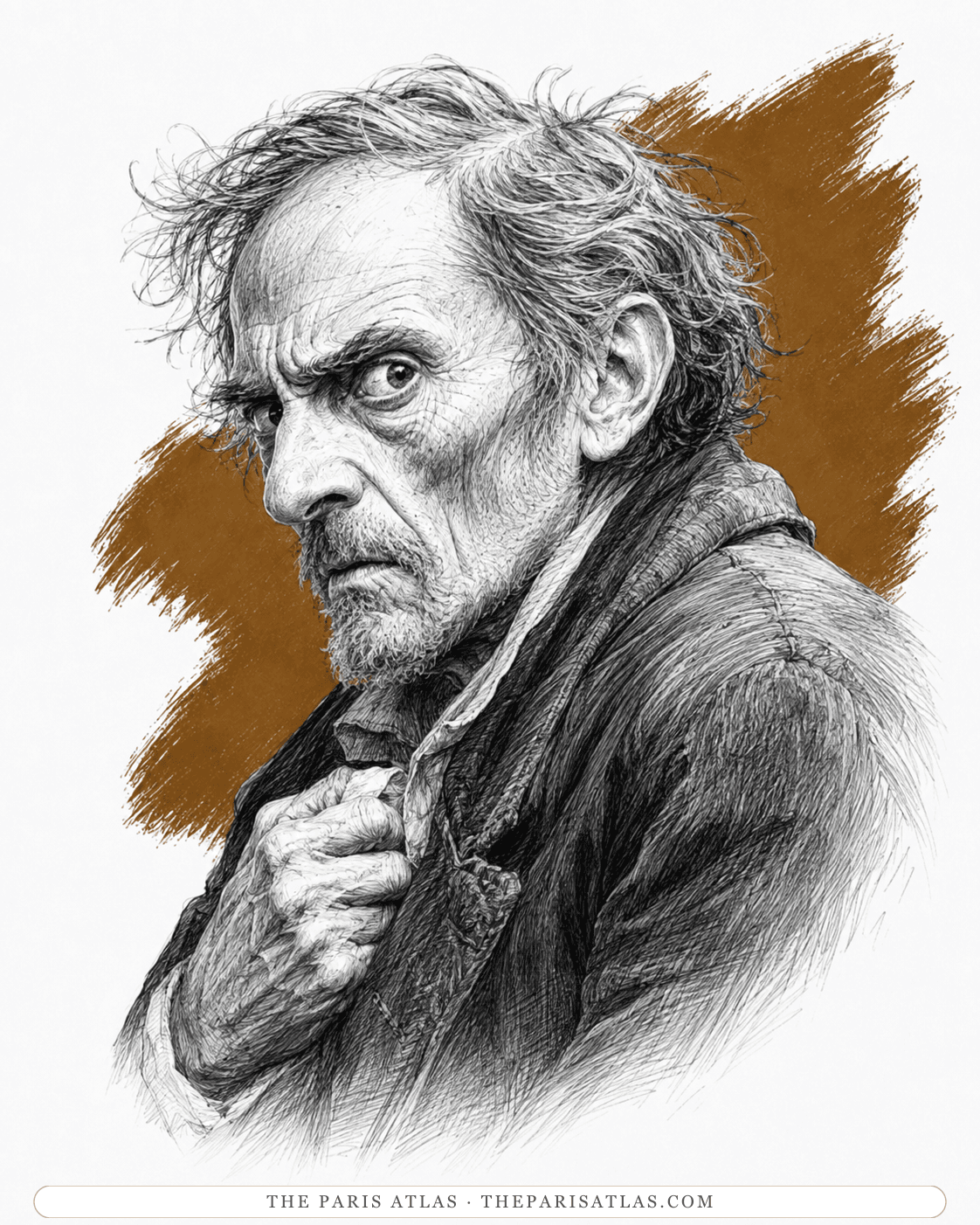
Roucolle
A miser of the narrator's Paris quarter who lived on damaged vegetables while holding half a million francs, and lost six thousand of them to a cocaine-smuggling scheme. He died before Orwell arrived, and the whole story reaches the book secondhand.
In the story Orwell was told, Roucolle wants to keep every sou he has and to multiply it without putting any of it at risk. He held half a million francs and ate cat's meat, and parting with six thousand took two men several weeks.
The book

At a glance
- A miser of the quarter Orwell calls the rue du Coq d'Or; named in Chapter I, told about in Chapter XXIII
- Seventy-four
- A year or two before Orwell arrived in Paris
- Half a million francs invested, and more than six thousand sewn into a mattress
- Six thousand francs, against a Sorbonne student's four thousand
- Charlie, a bistro talker Orwell says was very likely lying
Who they are in the book
Spoiler-freeRoucolle appears first as a name in a list. Describing the eccentrics of the slum quarter where he lodged, George Orwell mentions "Roucolle the miser" and adds that the man died before his time there. Roucolle was seventy-four when he died, a year or two before Orwell came to Paris, and people in the quarter were still telling stories about him. He had half a million francs invested and lived like a destitute man, on damaged vegetables and cat's meat, in a room he was gradually burning for firewood.
Chapter XXIII gives him the story that killed him. A young man arrived in the quarter with a plan for smuggling cocaine into England, claiming he could get it direct from Vienna rather than through the usual dealers, and that there would therefore be nobody to betray them and nobody to pay off. He reached Roucolle through a Polish student at the Sorbonne, who would put up four thousand francs if Roucolle put up six thousand; ten pounds of cocaine would be worth a small fortune once it was across the Channel. The two of them worked on Roucolle for weeks. He had more than six thousand francs sewn into his mattress and could not bring himself to touch it, and in the end he gave in out of exhaustion rather than conviction, slit the mattress open and handed the money over. The cocaine was delivered that same day and the seller disappeared.
Because Roucolle had made such a scene about the money, the whole quarter knew, and the police raided the cheap hotel where he lodged the next morning. They worked upwards, searching room by room, while the packet sat on Roucolle's table. The Polish student wanted to throw it out of the window and Roucolle would not allow it. Someone on the same floor had a dozen tins of face powder he was selling on commission; the powder went out of the window and the cocaine went into the tins, which were then set openly on the table. The police found nothing until the inspector noticed the tins on his way out.
How Roucolle Is Portrayed
- How he livedHe went to Les Halles every morning to pick up damaged vegetables. He ate cat's meat, wore newspaper instead of underclothes, burned the wainscoting of his room, and made himself a pair of trousers out of a sack.
- Where the money wasSewn into the mattress in his room. He slit it open himself to get the six thousand francs out, after weeks of refusing to.
- Greed against fearWhile the two men explained, bullied, coaxed and argued, Roucolle sat with his head in his hands, groaning and sometimes shouting aloud. He was very pious, and knelt down to pray for the strength to decide. It did not help.
- In the raidWith the police searching the floor below, he clasped the packet to his chest and fought off the men trying to take it from him, at seventy-four. He would sooner have gone to prison than thrown money out of a window.
- The groan that gave it awayThe police were about to leave when the inspector picked up the tins and asked what was in them. The Pole said face powder, calmly. Roucolle groaned aloud from fright, and the tins were opened.
- At the police stationHe wept, prayed, made contradictory statements and denounced the Polish student, all at once and loudly enough to be heard half a street away. The policemen laughed at him.
- The man who sold itOrwell's chapter gives him no name and identifies him throughout by his religion. He promised a route direct from Vienna, took the money, delivered a package the same day and vanished. He had run the same swindle on two other people in the quarter.
- SecondhandThe whole chapter comes from Charlie, a young man of family and education who had run away from home and lived in the quarter on remittances. Orwell introduces the story by saying that Charlie was very likely lying as usual, but that it was a good story, and Roucolle was dead before he ever reached Paris.
A tin was sent away for analysis while the two men were interrogated. The analyst's answer came back after an hour: Roucolle and the Pole were released and entirely exonerated.
The Polish student was glad enough to get out, even having lost four thousand francs. Charlie's diagnosis, which is the only one the book offers, was a broken heart.
If you like Down and Out in Paris and London


If you like George Orwell
Explore authors with a similar voice, perspective, and influence.

Henry Miller
The Brooklyn dropout who arrived in Paris broke at thirty-eight and wrote the exuberant, banned books that ended American censorship.
View author
Louis-Ferdinand Céline
The doctor of the Paris slums who wrote the century's blackest, funniest novel — and changed the sound of French prose.
View author
Simone de Beauvoir
French writer and philosopher whose novels, memoirs, and social analysis examined freedom, gender, responsibility, aging, and the material conditions that shape a life.
View author