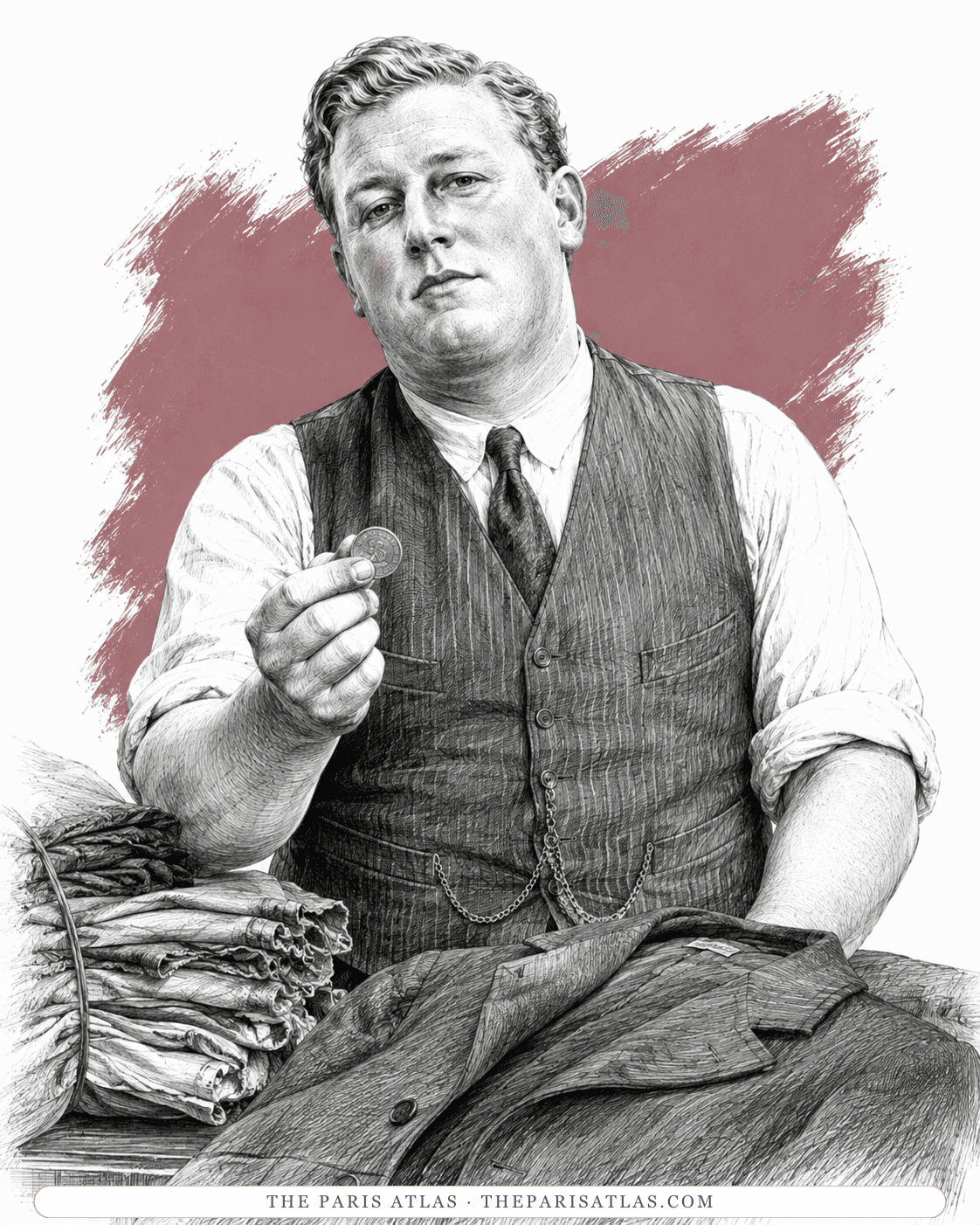
The Lambeth clothes dealer
The fourth rag-shop owner the narrator tried in Lambeth, a large blond young man very pink all over, like a slice of ham. He felt a good suit between finger and thumb, called it poor stuff, and traded it for a bundle of dirty rags and one shilling. As Orwell opened his mouth to argue he reached out as though to take the shilling back, and the argument ended there.
The book

At a glance
- A rag-shop keeper in Lambeth
- Never given
- A good suit for a coat, dungaree trousers, a scarf, a cap and one shilling
- Chapter XXIV
Who they are in the book
Spoiler-freeGeorge Orwell came back from Paris to a job looking after a man he calls a tame imbecile, and was told on arrival that the family had gone abroad and would not be back for a month. He had nineteen and sixpence. Not knowing how to get a cheap bed in London, he spent that night in a “family” hotel at seven and sixpence, which left him ten and twopence, and by the next morning he had made his plans: leave most of his things at a station cloakroom and exchange his second-best suit for cheap clothes and whatever cash he could get, on the reasoning that if he was going to live a month on thirty shillings he needed bad clothes, and the worse the better.
He went down to Lambeth, where the people are poor and there are a lot of rag shops. The first proprietor was polite but unhelpful, the second was rude, and the third was stone deaf or pretending to be. The fourth was a large blond young man, very pink all over, like a slice of ham.
He looked at the clothes Orwell was wearing and felt them disparagingly between thumb and finger. Poor stuff, he said, very poor stuff, that is. Orwell notes in the next breath that it was quite a good suit. Told that Orwell wanted older clothes and as much money as could be spared, he thought for a moment, then collected some dirty-looking rags and threw them on the counter: a coat once dark brown, black dungaree trousers, a scarf and a cloth cap. Asked about the money, he pursed his lips, produced a shilling and laid it beside the clothes.
Orwell was going to argue. As he opened his mouth the man reached out as though to take the shilling back again, and that ended it. He let Orwell change in a small room behind the shop.
What the trade bought was more than the clothes. Within an hour Orwell saw a hang-dog man coming towards him in the street and found it was his own reflection in a shop window; a hawker whose barrow he helped pick up called him mate, which nobody had ever called him before; and women he passed stepped away from him on the pavement. Orwell's chapter is about what a change of clothes does to the way a man is treated, and the shopman is the person who made the change.
How The Lambeth clothes dealer Is Portrayed
- How the book describes himA large blond young man, very pink all over, like a slice of ham. He is the fourth rag-shop keeper Orwell tried in Lambeth and the only one who would deal.
- How he valued the suitHe looked at what Orwell was wearing and felt the cloth disparagingly between thumb and finger. Poor stuff, he said, very poor stuff. Orwell records that it was quite a good suit.
- What he paidA bundle of dirty rags thrown on the counter — a brown coat, black dungaree trousers, a scarf and a cloth cap — and then, after a pause and a pursing of the lips, one shilling laid beside them.
- How the argument endedOrwell opened his mouth to object and the man reached out as though to take the shilling back. Orwell took the money instead, and was allowed to change in a small room behind the shop.
If you like Down and Out in Paris and London


If you like George Orwell
Explore authors with a similar voice, perspective, and influence.

Henry Miller
The Brooklyn dropout who arrived in Paris broke at thirty-eight and wrote the exuberant, banned books that ended American censorship.
View author
Louis-Ferdinand Céline
The doctor of the Paris slums who wrote the century's blackest, funniest novel — and changed the sound of French prose.
View author
Simone de Beauvoir
French writer and philosopher whose novels, memoirs, and social analysis examined freedom, gender, responsibility, aging, and the material conditions that shape a life.
View author