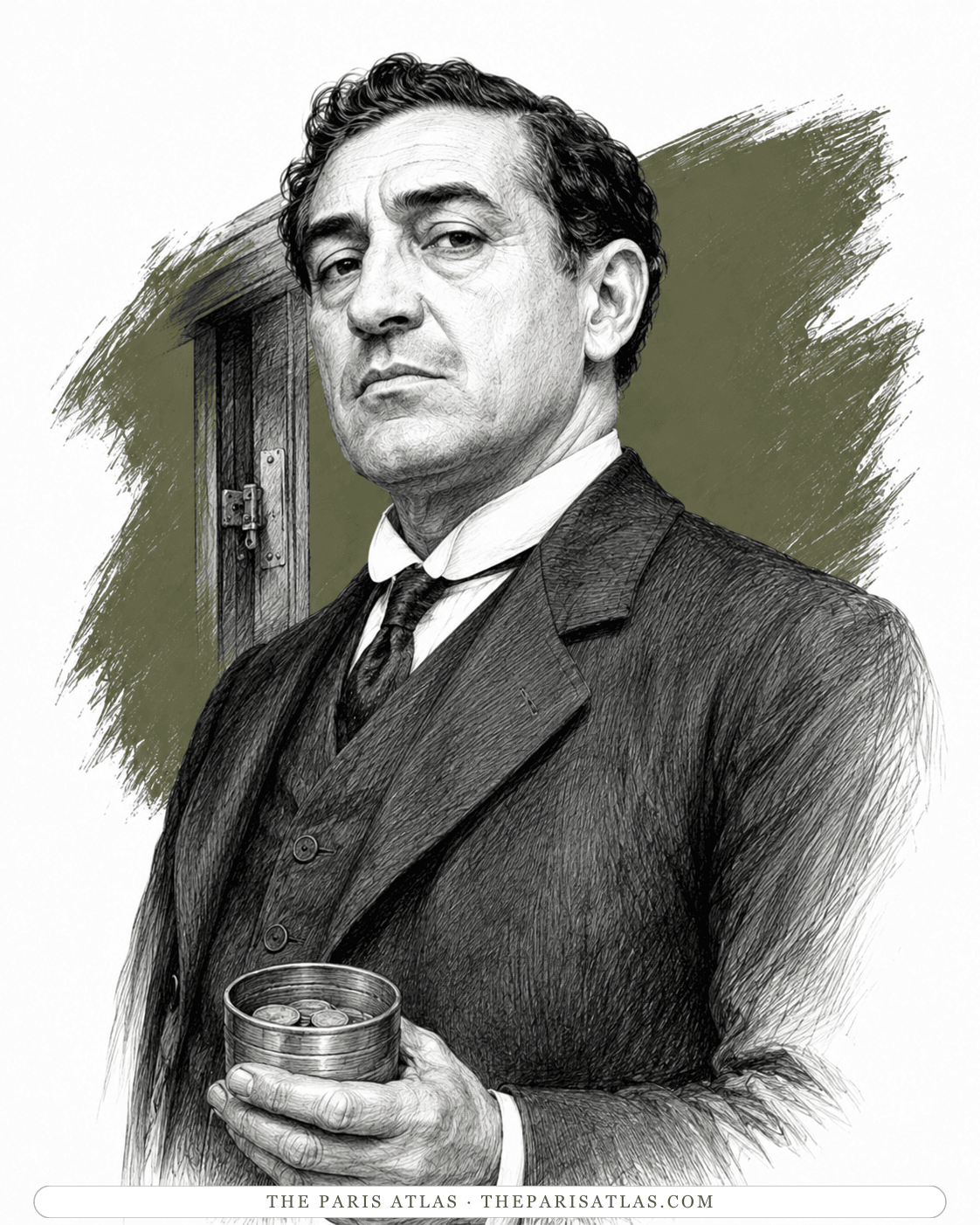
The doorkeeper at the Hôtel X
The man in the little office beside the service entrance of the Hôtel X. He checked the staff in, searched them for stolen food on the way out, paid their wages by hand, and cheated the narrator of a hundred and fourteen francs in six weeks.
In George Orwell's account, a cut of every wage packet that passes through his hands. He ran the same tricks on any employee green enough to be taken in, and Orwell was one of them for six weeks.
The book

At a glance
- Doorkeeper at the service entrance of the Hôtel X
- Never given
- Checking the staff in, searching them out, and paying the wages
- A hundred and fourteen francs from Orwell in six weeks
- Chapters IX, X and XIII
Who they are in the book
Spoiler-freeThe Hôtel X had a classical facade and, at one side, what George Orwell describes as a little dark doorway like a rat-hole. That was the service entrance, and the doorkeeper sat in a tiny office beside it. Every man in the basement passed him twice a day. Orwell had heard of him before he met him: on the bench in the Tuileries where Boris smuggled out minced veal and a wedge of Camembert under his waistcoat, Boris explained that he could not manage more, because the doorkeeper was a cunning swine.
The visible half of the job was the search. Orwell's first day was worked as an extra, at twenty-five francs. The doorkeeper counted the money out, less fifty centimes which he said was for insurance. There was no insurance, as Orwell found out later. Then he stepped into the passage, made him take off his coat, and prodded him all over for stolen food. Everyone else in the hotel stole. The waiters took food as a matter of course, the cellarman set aside a teaspoonful of brandy from every glass he poured and sold it at five sous a swig, and the men in the cafeterie drank the hotel's tea and coffee all day.
The other half was the wages. Orwell had asked to be paid daily, so the doorkeeper handed him sixteen francs each evening and nothing for Sundays, although Sundays were due: sixty-four francs. Sunday work carried an extra twenty-five francs, which Orwell did not know about and never saw: another seventy-five. He worked out in his last week that he was being cheated, could prove nothing, and got twenty-five francs back. Orwell's verdict is flat. In a hotel where everyone stole something, the man employed to search the others was the greatest thief in the building.
How The doorkeeper at the Hôtel X Is Portrayed
- What came past the officeA stream of men in greasy trousers, hurrying in through the service door and checked one by one from the tiny office beside it. Orwell gives the doorkeeper himself a single word of description in the whole book: sour-faced.
- The searchHe stepped out of the office into the passage each evening, made the man take his coat off, and went over him for stolen food. The hotel searched everyone on the way out, and there was good reason to.
- Fifty centimes for insuranceDeducted from the first day's twenty-five francs, with an explanation. Orwell records finding out afterwards that it was a lie.
- The missing SundaysSixteen francs a night, paid by hand, and nothing on Sundays, which were paid days. Sixty-four francs over six weeks.
- The Sunday workOrwell sometimes worked his day off when the hotel was short a man, which was worth an extra twenty-five francs. He was never told, and never paid: another seventy-five francs.
- The greatest thief in the hotelOrwell's phrase, written about a staff in which the cellarman skimmed the brandy and the waiters kept stolen food behind the crockery. Only twenty-five of the hundred and fourteen francs came back, and only because he complained in his last week.
- What he called himselfA Greek. Orwell says he was in fact an Armenian, and follows the sentence with a proverb about which nationalities can be trusted, which is the sort of thing the book prints without comment.
If you like Down and Out in Paris and London


If you like George Orwell
Explore authors with a similar voice, perspective, and influence.

Henry Miller
The Brooklyn dropout who arrived in Paris broke at thirty-eight and wrote the exuberant, banned books that ended American censorship.
View author
Louis-Ferdinand Céline
The doctor of the Paris slums who wrote the century's blackest, funniest novel — and changed the sound of French prose.
View author
Simone de Beauvoir
French writer and philosopher whose novels, memoirs, and social analysis examined freedom, gender, responsibility, aging, and the material conditions that shape a life.
View author