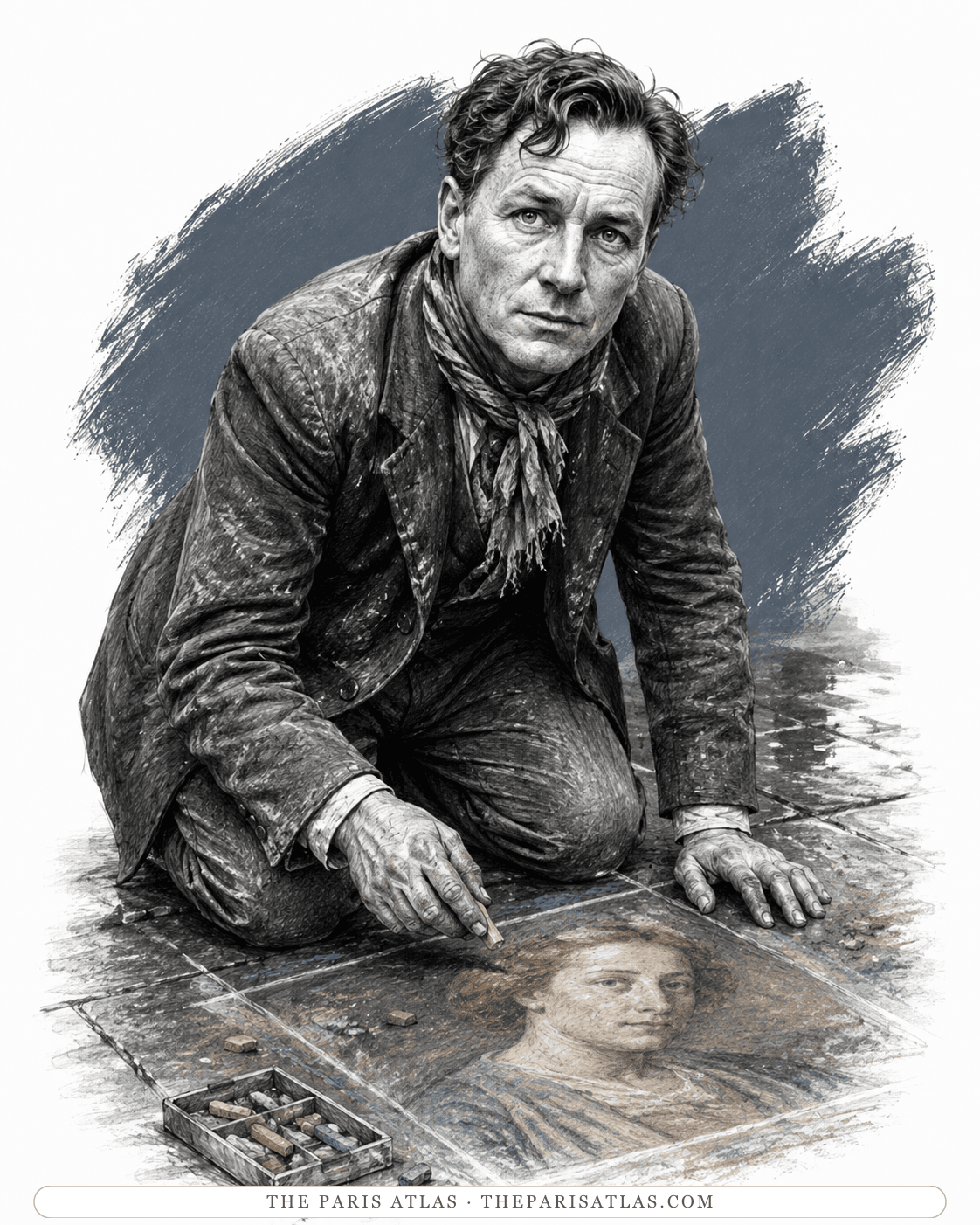
The screever who had shown at the Salon
A pavement artist Bozo introduced to the narrator: a trained painter who had submitted to the Paris Salon, took up chalk on an impulse one starving night in the Strand, and now copies Old Masters on stone for a pound a week.
In George Orwell's account, to keep six children fed on what a pavement will give. He was carrying his drawings home from the dealers on the night he first knelt down in the Strand.
The book

At a glance
- One of the screevers on the Embankment, introduced to Orwell by Bozo
- Never given
- Studied art in Paris; submitted pictures to the Salon
- About a pound a week
- Chapter XXXI
Who they are in the book
Spoiler-freeGeorge Orwell writes that screevers can sometimes be called artists and sometimes not, and it was Bozo, the screever he spent his London month with, who introduced him to one who was a real artist. The man had studied art in Paris and submitted pictures to the Salon in his day. His line on the pavement was copies of Old Masters, which Orwell says he did marvellously, considering that he was drawing on stone.
He described how he started. He was walking home late one night with a portfolio of drawings he had been taking round the dealers, wondering how to raise a shilling or two, with a wife and six children going hungry at home. In the Strand he saw a man kneeling on the pavement drawing while people dropped pennies, and when that man got up and went into a pub he knelt down on the spot and began drawing with the abandoned chalks. He had never used pastels in his life and learned the technique as he went. People stopped, said the drawing was not bad, and gave him ninepence between them. Then the other screever came out of the pub and asked what he was doing on his pitch. Told that the man was hungry, he took him in for a pint. He has been a screever ever since, on about a pound a week, with his wife taking in sewing.
The cold is the worst thing about the life, he told Orwell, and after the cold the interference. Not knowing any better at first, he sometimes copied a nude. The first was outside St Martin's-in-the-Fields, and a man in black, a churchwarden or something of the kind, came out in a rage demanding to know whether they could have that obscenity outside God's holy house; he washed it off. It was a copy of Botticelli's Venus. He drew the same picture again on the Embankment, and a policeman looked at it, said nothing, walked onto it and rubbed it out with his boots.
How The screever who had shown at the Salon Is Portrayed
- What he drawsCopies of Old Masters in pastel, which Orwell rates as marvellous given that the surface is paving stone.
- The night he startedLightheaded with hunger, he knelt on another man's pitch in the Strand with borrowed chalks, having never handled pastels before, and took ninepence.
- The other screeverCame out of the pub, asked what he was doing on his pitch, heard that he was hungry, and stood him a pint.
- The householdA pound a week from the pavement, six children, and a wife who takes in sewing. He says plainly that you cannot keep six children on a pound a week.
- Botticelli, twiceA man in black came out of St Martin's-in-the-Fields to call his copy of the Venus an obscenity outside God's holy house, and he washed it out. He drew it again on the Embankment, and a passing policeman rubbed it out with his feet without a word.
If you like Down and Out in Paris and London


If you like George Orwell
Explore authors with a similar voice, perspective, and influence.
Henry Miller
The Brooklyn dropout who arrived in Paris broke at thirty-eight and wrote the exuberant, banned books that ended American censorship.
View author
Louis-Ferdinand Céline
The doctor of the Paris slums who wrote the century's blackest, funniest novel — and changed the sound of French prose.
View author
Simone de Beauvoir
French writer and philosopher whose novels, memoirs, and social analysis examined freedom, gender, responsibility, aging, and the material conditions that shape a life.
View author